


Ask a man where his rights come from and he will point to the sky, or to a document, or to nothing at all. He believes a right is a thing he simply has, the way he has two hands. It arrived on its own. No one made it. It will be there tomorrow whether he tends it or not.
That belief is a child’s belief, and it is costing us the very rights we imagine are safe.
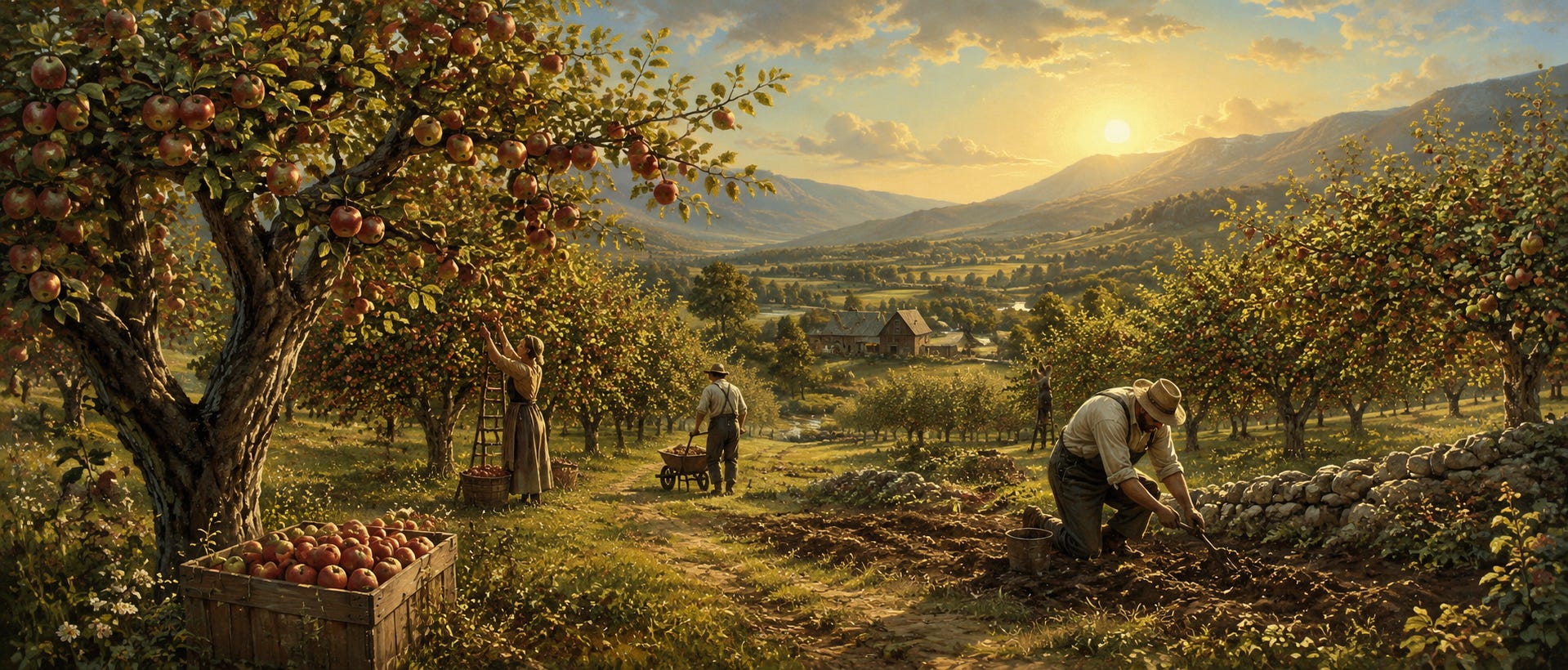
A right is grown, like an apple. You cannot stand in an empty field and demand an apple. You plant the tree, you guard it for years, and one day it bears fruit.
Some of the men who plant an orchard die before the first harvest. They plant it anyway, for children they will never meet. Every right you hold today was planted by men who are now dust, and it will feed your grandchildren only if you keep the orchard alive.
Rights must be produced. They can not just be demanded. Hold onto that sentence, because the whole argument grows out of it.
What a Right Actually Is
Most of the confusion about rights comes from a bad definition, so let us fix the definition first. Ask people what a right is and you get three answers.
The first is the child’s answer. A right is something you simply have, granted by God or by nature, present from birth, requiring nothing from anyone. This is how a small child understands food. Food appears on the table. Mother makes it appear. The child knows nothing of the farmer, the truck, the store, or the hours his father worked to pay for it. He knows only that he is hungry and the food comes.
Most grown men understand their rights exactly this way. The right is simply there, and someone, somewhere, makes it appear. This is the right that does not exist. It never did. It is the thing this essay denies.
The second answer is better. A right is a rule written down, in a constitution or a law. This is closer, because at least it points to something a man made. But a rule on paper is only ink until someone enforces it. Write “the innocent shall not be imprisoned” on the finest parchment, hand it to a man in a country where the police take bribes and the judges take orders, and see how much freedom the parchment buys him. The words are real. The right is not, because nothing stands behind the words.
The third answer is the true one. A right is a product. It is the standing result of reciprocal responsibility distributed across a whole society, the fruit of many people doing their part, year after year, so that a promise made on paper is kept in fact. A right is what you get when enough people accept the burden of making it real. Remove the people, or corrupt them, and the right goes away, though the words remain.
A right works like insurance. Many people agree to carry a share of the cost of protecting one another, so that each is covered on the day he cannot protect himself. You pay in with your labor, your taxes, and your restraint, and in return you are defended when your own arm is not enough. A right is the payout of a policy an entire society keeps funding.
A right is real the way a contract is real. A contract is not a stone you can hold, and it is not a fantasy either. It is a real thing that real people made and agreed to keep.
A right is real in that same way, and so is love. Love moves men to marry, to work, to sacrifice, to raise children they will spend themselves on. Love is known through conduct rather than declaration. It lives in what people do for one another day after day. Let the conduct stop and the love stops with it. The word remains and means nothing.
A right lives as long as people keep producing it. Let the work stop, and the right is as gone as the love.
An Orchard Has Limits
An orchard does not yield on command, and neither do rights. Three things bound what any society can produce.
The first bound is time. A tree bears fruit years after it is planted, and a right can take generations to become real. The conditions that let a man speak his mind, own his home, and walk the streets in safety were built slowly, by people who mostly did not live to see the finished work. A man born into those conditions inherited them from his ancestors. He did not make them alone.
So the honest question about any right is the question you would ask in an orchard. Who planted this tree, and how long ago?
The second bound is the size of the field. A given field, worked by a given number of hands, yields only so much fruit in a season. Rights obey the same law. Each one costs something to produce, and no society has unlimited hands or unlimited hours.
It would be a fine thing if every person held the right to earn a thousand dollars an hour. Say the words and nothing happens, because the wealth to honor that promise does not exist. You may declare the right. You cannot produce it. A right you cannot produce is just a wish.
The third bound is nature, which does not ask our permission. A farmer can do everything correctly and still lose the crop to drought or frost. A society can do everything correctly and still lose a right to circumstance. When the earthquake comes, a man loses his freedom to enter the district he walked through yesterday, because the ground is no longer safe and other men must keep him out to keep him alive. Under martial law and emergency, rights that stood for a lifetime bend or fall.
This is the honest place where a right stops behaving like a simple machine. An apple needs only labor and cooperative weather. A right needs labor, cooperative nature, and something harder to secure than either: the continued reciprocal cooperation of many people to keep honoring it. Withdraw any of the three and the fruit does not come.
Every Right Is a Bill Someone Pays
Take the right men prize most: the right to speak freely. Most people believe it requires one thing only, that no one silence them. That is the smallest part of it.
Free speech that means anything rests on the labor of a great many people:
Parents who raise honest children.
Teachers who teach those children to read, reason, and tell the truth.
Citizens who fund the schools.
Workers whose surplus pays for the courts.
Merchants and employers whose trade produces the surplus that pays for all the rest.
Judges who apply the law without fear or favor.
Police who keep the mob from the door of the man with the unpopular view.
Officials who stamp out corruption instead of joining it.
Citizens who hold their government to account.
Jurors who weigh the evidence honestly.
Soldiers who preserve the sovereignty within which the argument can go on at all.
Neighbors who answer a lie with a better argument in place of a rope.
Every item on that list is a responsibility somebody shoulders. Together, these people insure the conditions under which free speech can exist. Let enough of them set the work down and free speech thins out and disappears. No one need vote against it. It fails because the people who were producing it stopped.
A demand for a right is a demand upon other people. When you claim your right to speak, you are claiming a portion of their time, their labor, their property, the risks they run, and in the case of the soldier, his very life. The right is the fruit. Keeping the orchard alive is their responsibility.
Follow the chain that produces it:
responsibility → reciprocal cooperation → surplus → institutions → insurance → a right
There Is No Such Thing as a Negative Right
Here the argument parts from the tradition, so let me be plain about where and why.
For a long time, careful thinkers have sorted rights into two kinds. A positive right, they say, obliges someone to give you something: food, shelter, a wage, a hearing. A negative right obliges others only to leave you alone, to not kill you, not rob you, not silence you. The positive right costs somebody labor. The negative right, they claim, costs nothing, because it asks only that people refrain.
This is a mistake, and it comes from incomplete accounting of production and insurance. The men who drew the line counted the cost of the giving and forgot to count the cost of the leaving alone.
Do the full accounting. Your right to speak without censorship looks free, because it seems to ask only that others hold their tongues and their hands. But you cannot hold that right by yourself. Alone, you cannot stop the government from jailing you, and you cannot stop a mob from dragging you into the street. The only thing that keeps either one off your back is other people, many of them, agreeing to stand between you and the men who would silence you, and paying what that defense costs in taxes, in institutions, in time, in risk, and sometimes in blood. Take that cooperation away and your freedom from censorship is gone by the same afternoon, however many people were willing to leave you alone. We have watched it happen in every society where cooperation broke down.
The right to be let alone is worth exactly as much as the reciprocal insurance standing ready to defend it, and that insurance, like all insurance, rests in the end on force held in reserve. None of it is free.
So there are no negative rights. There are only positive rights. Every right is a claim on the labor and the restraint of others. Some claims are heavy and some are light, and the honest distinction is not between rights that cost and rights that do not. It is between rights that cost little and rights that cost much, between the ones most people are glad to fund and the ones they resent funding.
Run the same chain backward and you see why a costless right cannot exist:
no surplus → no institutions → no insurance → no rights
A right that truly asked nothing of anyone would be a right that nobody was producing, which is to say no right at all.
This is not a grim discovery. It is the foundation of everything good about living among other people. The reason we cooperate at all is that each of us agrees to carry a little of the other’s burden, so that both of us stand stronger than we could alone. I help defend your freedom because I want mine defended, and the same institutions defend us both for less than it would cost either of us standing apart. That shared and mutually accepted cost is the seed of every institution worth having.
But it holds only while the agreement holds. A society can carry any right its members agree to fund together. It cannot carry rights that some demand and others refuse to defend. When enough people claim rights they are unwilling to help pay for, and expect a shrinking number of others to cover the bill, the arrangement stops working, and no speech about entitlement will make it work again. Much of the West is learning this now.
What the Orchard Asks in Return
If a great many people carry responsibilities so that you may speak, a fair question follows. What may they ask of you in return?
Begin with what they may not ask. Your speech owes them no comfort. They cannot require you to flatter their leaders, share their opinions, or hold your tongue about what you believe. Criticism, dissent, and unwelcome truth cost a man nothing except his composure, and that is his burden to carry. When your words offend him, you have not reached into him and planted the injury. He has chosen to take offense. Offense is a cost a man levies upon himself, and what he chooses he can also decline.
Fraud is another matter. If you use your speech to lie a man out of his money, to swear falsely against him in court, to sell him a medicine you know will harm him, to bait him into a hazard he cannot see, then you have imposed a cost he never agreed to carry. He cannot choose his way out of it the way he can choose his way out of offense. The cost is real, it is imposed from outside, and it can be measured.
Measurement is the whole test, because measurement is what makes a claim decidable. If a harm cannot be measured, then no harm can be shown, and a man who cannot show harm is asking you to punish on his word alone.
This is not a new or strange standard. It is how a court already works. Claim that a man defamed you and you do not win by saying you feel wronged. You win by proving a loss: the job that fell through, the contract withdrawn, the customers who walked away. Until you show the harm, you collect nothing. The point of the measure is decidability: it lets an impartial judge settle the matter by proof instead of by sympathy.
The measure need not be perfect. It needs only to be close enough to establish that a real cost was moved from you onto another man without his consent. Hurt feelings fail this test, because there is no cost to find outside the man’s own choice to be wounded. A ruined business passes it, because the loss sits in the ledger whether he broods on it or not.
That is the line. Speech that displeases is protected, because the cost lives in the listener and he holds the power to set it down. Speech that injures is not protected, because the cost is imposed from outside and the victim has no such power.
This is why you hold no claim on my cooperation. I protect your freedom to speak because I want the same freedom for myself, and the bargain serves us both. Turn that freedom into a weapon against me, against my children, against the people I am bound to protect, and you have given me no reason to keep spending myself on your behalf. I have not silenced you. I have withdrawn my labor from a man who used the protection I paid for to rob me.
One case looks like injury and is not. Suppose you expose a crime I committed, and the exposure ruins me. You have harmed me, and yet you have imposed nothing. The cost was set in motion the day I committed the crime, and it belongs to me. You are not the author of my ruin. I am. This is the difference between the man who defames and the man who reports, and every sound legal system already keeps them apart. This framework did not invent that distinction. It explains the distinction the law arrived at long ago.
Institutions Are Where Responsibility Is Pooled
No man produces his own rights alone. He is not strong enough, not skilled enough, and not awake enough hours in the day. So men do with responsibility what they do with every task too large for one pair of hands. They pool it.
Institutions do not eliminate responsibility. They distribute it.
That is what an institution is. A court, an army, a church, a company, a market, a family, an insurance fund: each one gathers the responsibility that no single member could carry and spreads it across many. The gathering is what makes the impossible possible.
Pooling lets men specialize, and specialization is where the wealth of a civilization comes from. Not every man can stand on the wall. The child cannot. The blind man cannot hold the line. A woman has not the strength for the shield wall. Set them all to fighting and you have a poor army and no bread.
Let each do what he does well and trade for the rest, and the account changes entirely. The blind man forges the blade. The farmer grows the grain. The strong man carries the shield. The farmer need not fight, and the soldier need not go hungry while he stands guard. Each is safer and freer than any of them could be alone.
Pooling protects a man across time as well, and this is the part men forget. However strong you are today, age will take it from you. The man who stands in the shield wall knows he may not walk home. He holds the line anyway, because he knows that if he falls, the group will feed his wife and raise his children. He spends his life on a defense he will not live to enjoy, and he does it willingly, because the institution promised to carry what he no longer could. The institution is a man’s insurance against his own certain weakness. It covers the helplessness of the cradle at one end of life and the helplessness of the grave at the other, and every illness, injury, and misfortune between them.
This is how rights come to exist that no lone man could ever hold. Alone, a man has only the rights he can defend with his own body, in this moment, while he is awake and strong. Everything beyond that, the right that holds while he sleeps, while he is sick, while he is old, is produced by other people who have accepted responsibility for him.
This is what an institution really does with responsibility. It stores it, the way an economy stores labor as capital:
labor → stored labor → capital
responsibility → stored responsibility → a right
A right is not merely produced by responsibility. It is responsibility saved up, held in trust by an institution, and paid back to you on the day your own strength is not enough.
There is a right way to pool responsibility and a way that rots the whole arrangement, and they look almost the same from outside. When I pay for the court, serve on the jury, and testify honestly, I have delegated a responsibility I still own. I cannot run a justice system by myself, so I pool my share with yours and we build one together. I still carry my part. That is delegation, and it builds the institution.
When I decide the court is someone else’s affair, dodge the jury summons, and lie under oath when it suits me, I have handed my responsibility to no one and washed my hands of it. That is abdication, and it hollows the institution out. The building still stands. The work inside it stops.
What changes is the man inside it. A jury system staffed by men who come willingly produces justice. The same system, with every man scheming to escape the summons, produces a courthouse with no justice in it.
There is a worse way still, and it wears the badge of responsibility while doing its opposite. A man keeps his place inside the institution and turns it to his own account. The judge who sells his verdict, the official who steers the contract to his cousin, the inspector who pockets the bribe and signs the paper: each still holds his office, still draws the title and the pay, and quietly converts a thing built for everyone into a thing that serves himself and his own kin.
This is corruption, and it does more damage than the empty chair, because the empty chair is at least honest. The corrupt man spends the trust of everyone who depends on the office, and every right that passes through his hands is bent, sold, or handed to his family. An institution can survive a man who does too little. It rots from the man who uses it for himself.
Every group must therefore find a balance, which is the whole art of governing. Push everything toward the individual, each man for himself, and no one guards his neighbor; the weak are eaten, and the strong are eaten in their turn when they finally tire. Push everything toward the collective, all things shared and nothing owned, and no man troubles to pull his weight, because his effort vanishes into the common pot and returns to him whether he labored or loafed.
Neither extreme survives contact with human nature. The workable answer is an optimum, and the optimum is rarely the exact middle. It is whatever distribution of responsibility produces the most reciprocal cooperation while leaving the free-rider the least room to hide, and each people must find that setting for itself. Almost no one in public life will say this plainly, because both extremes make better slogans than the truth does.
Who Threatens the Orchard
An orchard has enemies. The careless lump together people who have little in common.
Most of what looks like a drain on the orchard is investment. A child consumes for years and has not yet entered production, and no sane man calls a child a parasite, because everyone understands that the child is an investment. Raise him well and he becomes a producer who feeds others in his turn.
This is why a society guards its children, and the children of its neighbors. An investment neglected today becomes a burden tomorrow, and a child hobbled in his upbringing is a debt the whole community will pay.
The mother who raises those children belongs here too, though the ledger of the market calls her idle. She earns no wage. She produces the next generation, and a people is in the end about the production of its next generation and not the sum of its wages. Three or four or five children raised into capable adults is a contribution equal to any career, and larger than most. Her husband’s investment in her, and the community’s investment in both, is among the soundest investments a civilization makes.
The fallen soldier’s family belongs here, and the blind smith, and the old man who built what the young now use. The soldier invested his life and his family draws the return. The smith sees nothing and forges well and stands on the giving side of the ledger. None of them takes without giving.
The second group is the small number of people who genuinely cannot care for themselves and never will. They are rarer than the sentimental imagine. Where they exist, their family carries them, and past the family the extended family, and past that the community.
They are carried because they are human, and because they remain members of the same insurance pool that covers the rest of us, owed protection on the day fate has left them unable to earn it. A people that will not carry its helpless has lost its humanity. Almost no one resents this cost.
The third group is the danger. Some people take and never give though they could give, and drain the orchard by habit. Others go further and set out to harm it: the man who defrauds, the man who preys, the man who would burn the orchard and kill the workers standing in it. These are not the helpless, and confusing the two is how a society comes to grief. Almost no one objects to feeding a man who cannot feed himself. What breaks a people is the failure to stop the man who means it harm.
Keep the idler and the destroyer apart, because they are different problems with different answers. The man who takes without giving, though his hands work, drains the orchard slowly, and the harm he does is the slow harm of a field worked by fewer and fewer hands. The man who burns and preys destroys it quickly. The first is a problem of incentives. The second is a problem of restraint. Treat them as one and you will be too harsh with the idler and too soft with the arsonist.
The slow drain raises a hard question, and it is an ancient one, older than any constitution. What becomes of an orchard when the men who never tend it are the men who vote on how the fruit is divided? A man who consumes more than he produces, and who also holds the power to decide how much he consumes, will vote himself a larger share every time, because the vote costs him nothing.
No company lets its suppliers sit on the board and approve their own invoices. The reason is not contempt for suppliers. The reason is that no man should be the judge of his own claim on the common store.
The aim is to preserve one thing: the incentive that keeps a productive man producing. Let the idle vote themselves his harvest and that incentive dies, and when it dies the harvest dies with it.
The destroyer raises a different question. Some who would harm the orchard are not answerable for what they do. The violent madman did not choose his madness. Grant it. The responsibility to prevent his harm does not vanish because he cannot carry it.
Here is a law worth stating plainly: responsibility is conserved. It can be delegated, transferred, pooled, or inherited, but it can never be abolished. It is not destroyed when the man who held it lets go; it passes to someone else. I am responsible for my child. If I die, my wife takes it up. If she dies too, my brother or my neighbor does. The duty ends in only one of two ways: when it is discharged, as a debt ends when it is paid, or when the person it protected is gone. Short of that, it always lands on someone.
So when the madman cannot answer for the harm he will do, the duty to stop him falls to the rest of us, because a responsibility no one holds is not a thing that exists. We do what the case requires, which may mean confining him where he can do no injury. Whether we confine him well or badly is a real question and a separate one. The point that stands is simpler. Somebody is always responsible. When the man himself cannot be, we are.
The Harvest Fails for Everyone
Put these together and you can see how a civilization dies. It rarely arrives in a single blow. It arrives by arithmetic.
Men grow tired of their responsibilities and set them down. The institutions those responsibilities fed grow weaker. As the institutions weaken, the rights they produced become harder to enforce.
And here the fatal turn arrives. As rights grow harder to enforce, men do not take up their responsibilities again. They demand more rights instead, louder than before, and each new demand lays a heavier load on the smaller number of people still doing the work. Those people carry it for a while. Then they too grow tired, or leave, or stop. Fewer hands. Weaker institutions. Fewer rights. Louder demands. The wheel turns faster each time it comes around.
Here is the wheel, drawn out:
less responsibility → weaker institutions → fewer rights → louder demands → still less responsibility
It feeds itself. Each turn makes the next turn easier, until there is nothing left to turn.
This is a truer account of decline than the usual one. Men did not simply grow selfish. They came to believe that a right is a thing you are owed rather than a thing you produce, and having believed it, they stopped tending the orchard and began to quarrel over the fruit.
The quarrel grows bitter as the fruit grows scarce. The orchard, untended, yields less each year, until the season comes when it yields nothing, and there is nothing left to quarrel over.
A right is not a possession you own and may take for granted. It is a warranty, produced by the labor of many and renewed only by their continued reciprocal effort, and it lasts as long as that effort continues. Stop the work and the warranty voids itself, whatever the paper says.
A right exists the way love exists. Both are real. Both are made of what people do, not of what they declare. And both die the same quiet death.
When people stop loving, the marriage remains on paper and stands empty. When people stop tending their responsibilities to one another, the rights remain on paper and stand empty.
A right lives as long as men keep producing it, and not one day longer. If you want to keep yours, tend the orchard.