


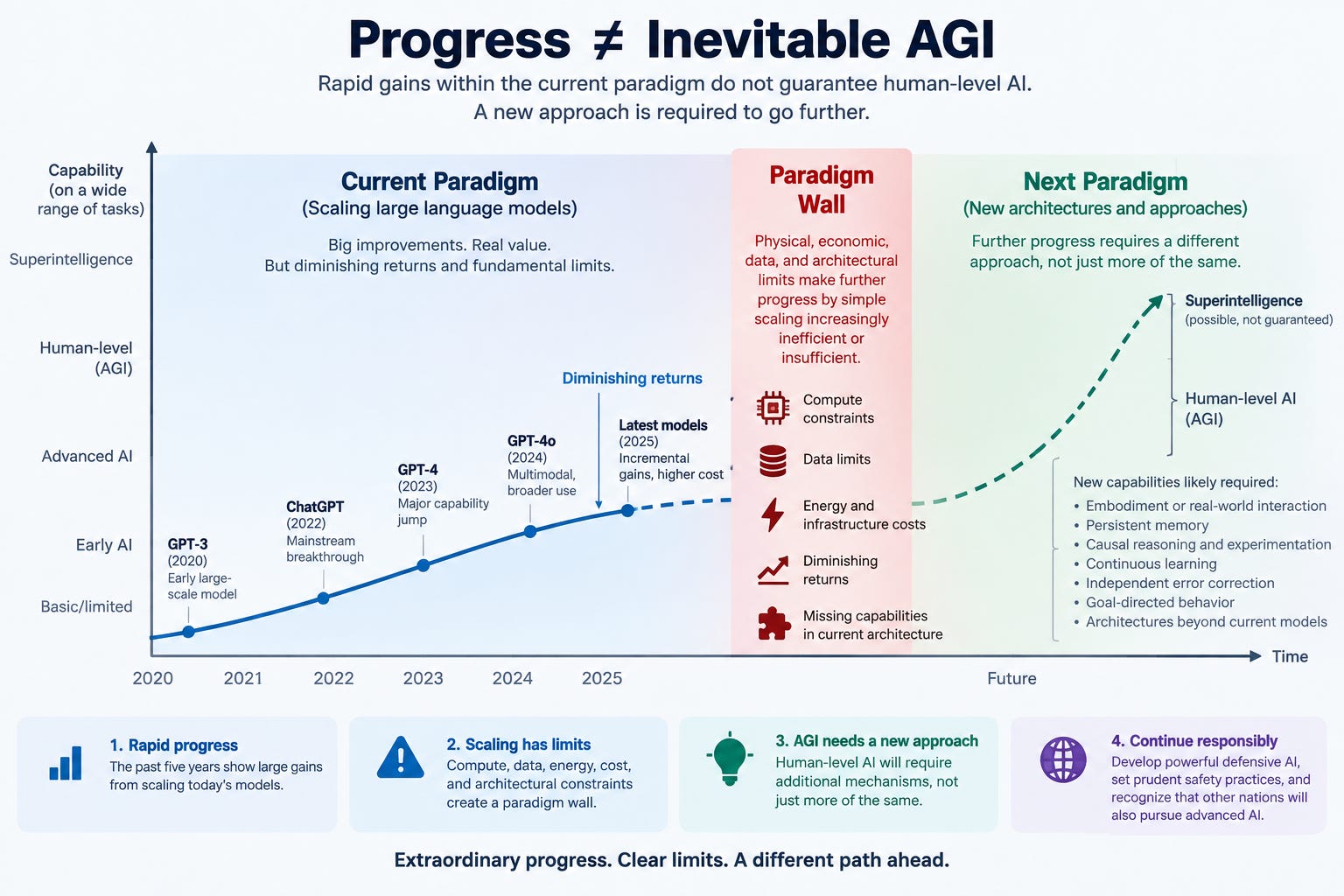
Artificial intelligence has improved extraordinarily quickly over the last five years. But projecting that curve forward indefinitely does not get us to AGI, much less superintelligence.
That projection mistakes progress within a technological paradigm for removal of the paradigm’s limits.
AI Inherits the Products of Human Intelligence
Human beings spent thousands of years discovering how the world works. We explored, experimented, built machines, developed mathematics, created institutions, wrote software, made mistakes, and learned from them.
Then we recorded some of what we learned in books, papers, programs, images, databases, and eventually the internet.
A scientific paper is not merely a record of a scientist’s mind. It is a record of what happened after a scientist used that mind to interact with the world.
The actual chain looks more like:
mind → observation → hypothesis → experiment → consequence → correction → discovery → written account
The written account is several steps removed from the process that produced the discovery. It records a relatively small set of selected results of that process after reality has already tested them.
The experiment itself leaves out much of the scientist’s internal process. The paper then leaves out much of the experiment: failed attempts, discarded hypotheses, tacit knowledge, judgment calls, sensory information, equipment behavior, environmental conditions, and everything else the author decided wasn’t necessary to report.
Modern AI is trained largely on the records at the end of this chain.
So AI learns from representations of the products of human thought and action.
Humans performed the experiments, suffered the failures, paid the costs, discovered what worked, and compressed some of the surviving results into language. AI begins downstream of that process.
Scaling the AI to better read those records does not reconstruct the machinery that created them.
Intelligence Requires Closing the Loop
Human intelligence does more than recognize patterns and produce answers.
We:
observe → measure → model → predict → act → encounter consequences → detect errors → correct → remember → try again.
Reality tests the model.
Language records and communicates what we learn from this process. It is not the process itself.
This explains one of the odd characteristics of today’s AI: enormous knowledge and rapid synthesis combined with mistakes an intelligent person would immediately recognize.
Eliminating those mistakes makes AI more reliable. Reliability and intelligence are not the same thing.
Scaling Has Limits
More data, computation, and better training have made AI much more capable. But no engineering process scales without constraints.
Compute costs money. Chips require factories. Data centers require electricity, cooling, networking, land, and capital. High-quality training data is limited. Every additional improvement has to justify the resources required to obtain it.
The relevant question is not:
Is the next model better?
It is:
How much better, at what, and at what cost?
A technology can continue improving while the return on additional investment collapses.
More importantly, increasing the power of operations a system already performs does not supply operations its architecture lacks.
AGI Requires Another Step
AGI requires more of the complete intelligence loop: persistent memory, causal modeling, experimentation, interaction with the environment, continuous learning, independent error correction, planning, and the ability to discover knowledge that was not already contained in its training material.
Today’s models can be components of such systems. They are not the complete architecture.
The next step may combine language models with other systems, replace parts of the present architecture, or introduce mechanisms we have not discovered yet.
This is how technological development works.
We did not obtain modern aviation by making the Wright Flyer larger. We did not obtain modern computers by building larger vacuum-tube machines. When a technological paradigm exhausts its useful improvements, we find another one.
Scaling Is Not a Superintelligence Argument
There is an enormous difference between:
AI will continue getting better
and:
scaling today’s AI will create uncontrollable superintelligence.
The second does not follow from the first.
Today’s AI can cause damage, but the immediate danger is much more ordinary: badly designed systems, excessive permissions, poor security, inadequate testing, and irresponsible deployment.
Powerful systems should be monitored, compartmentalized, tested, and given only the authority they require.
The same applies to AI security. Defensive AI should inspect an environment, identify vulnerabilities, establish monitoring, and harden the system before adversarial AI is allowed to attack it.
Let the AI defenders inspect the building before inviting the AI burglars to find a way inside.
We Still Need Powerful AI
We cannot base security policy on the assumption that other states will abstain from advanced AI.
China, Russia, and others have every incentive to develop, acquire, copy, or steal strategically valuable AI technology. If one approach reaches its limits, they have the same incentive to search for the next one.
So the answer to dangerous AI cannot be no powerful AI.
It must include powerful defensive AI.
If attacks operate at machine speed, defense must operate at machine speed.
The Mistake Is Extrapolating the Curve
The mechanism responsible for the last five years of progress is not necessarily the mechanism that will produce the next fifty years of progress.
Today’s AI can transform the economy without becoming AGI. It can automate enormous amounts of intellectual work and become a nearly universal intellectual tool.
But physical resources are finite. Data is finite. Energy and capital have costs. Returns diminish. And scaling an architecture does not give it operations the architecture does not contain.
When the present paradigm runs out of economical improvements, we will search for the next one.
That is how technological progress works.
AGI will require another step, or several—not simply more GPUs.
And until that step exists, projecting today’s scaling curve through AGI and onward to uncontrollable superintelligence is not a sensible conclusion.
Back in 1972, Hubert Dreyfus in "What Computers Can't Do", put this in a simple analogy. He said that, to reach the moon you can find the tallest tree on the highest mountain and climb it. That will get you closer to the moon, but will not, of course, get you to the moon. His comment was directed to the "AI" of that era, always promising that it was closer than ever, and which was laughably primitive compared to what we have today and yet the principle is the same. Today, the mountain is higher and the tree is higher, yet the leap to AGI is just as unobtainable for the reasons that Dreyfus articulated in his work.