


A Threshold Achievement Before Any Ruling
Docket shot:
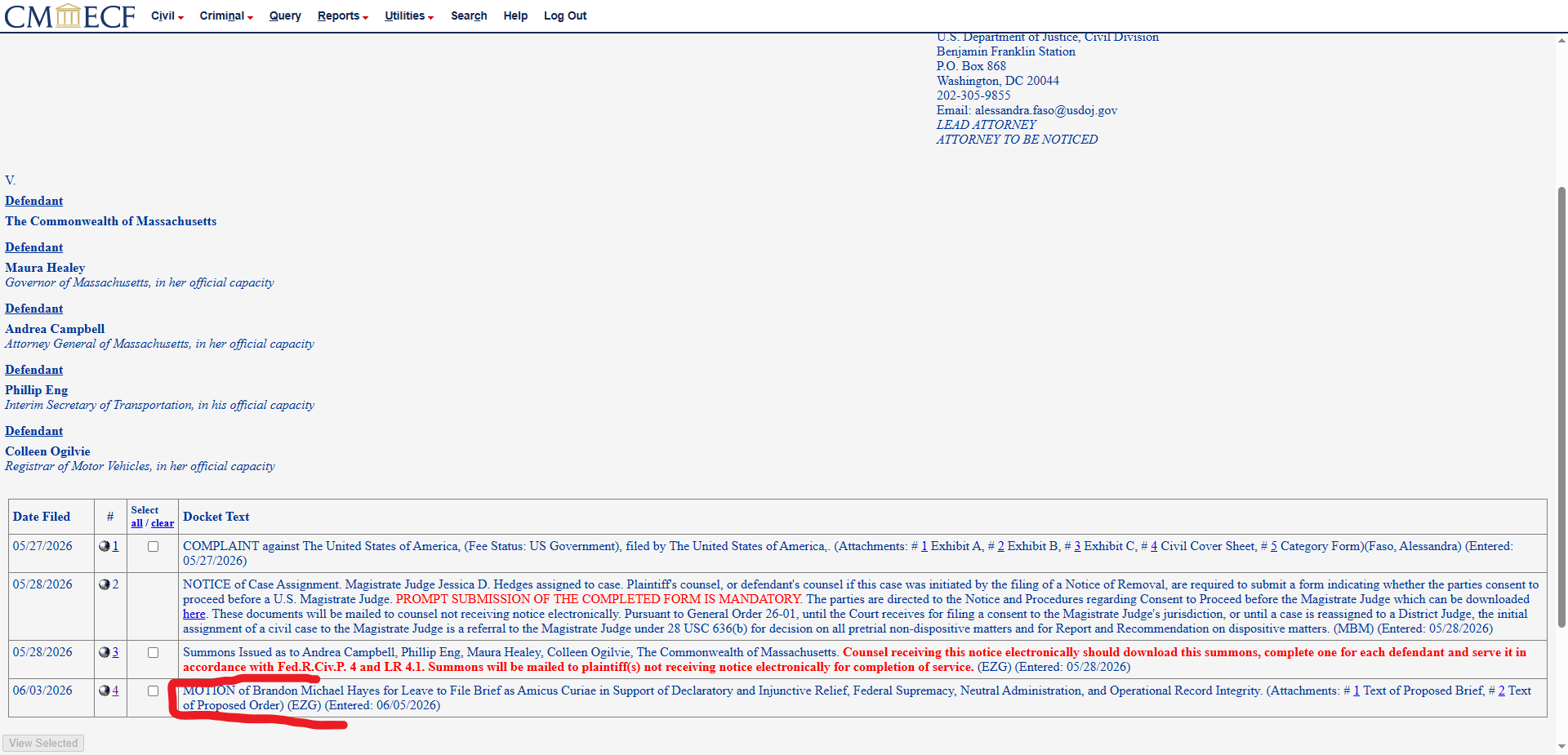
PDF file as entered into the court docket # 1:26-cv-12401-JDH:

I. A Threshold Achievement Before Any Ruling
This week, the United States District Court accepted and docketed our filing in the Department of Justice’s challenge against Massachusetts over confidential license-plate access for federal immigration authorities.
This matters even before any ruling, hearing, or judge decides whether our reasoning is persuasive, irrelevant, premature, or unwelcome because a foundational legal question has now been placed into the record. This is a threshold achievement.
The filing now exists as part of an official judicial proceeding. The question it raises now exists in a form the law must at least confront. The Court has custody of it. The parties have notice of it. The record preserves it. Future litigants may cite it. Future courts may distinguish it, reject it, refine it, or adopt it. Future scholars may examine it. Future citizens may discover that the question was, in fact, raised when it mattered.
So while no relief has yet been granted, something real has already occurred: a deeper legal issue has been preserved inside the machinery of adjudication.
That is a form of success modern people fail to recognize.
II. What People Misunderstand About Litigation
Most people misunderstand what litigation is for because they imagine that litigation begins when a complaint is filed and ends when a winner is declared. Plaintiff wins. Defendant loses. Motion granted. Motion denied. Case closed.
In that popular imagination, the case is merely a contest over outcome. Whoever gets the order gets the victory, and everything else is secondary.
But that is a dangerously narrow view of law, and a recklessly shallow view of courts.
Law is not just a mechanism for distributing victory and defeat but also the formal process by which a society explains itself to itself. It is the venue in which institutions are forced to say, with attempted operational precision, what they think they are doing and why they think they may do it.
Courts create records of reasoning, omission, distinction, refusal, adoption, hesitation, and principle. They do not only decide cases. They reveal the operating grammar of a civilization.
Every serious case contains at least two opportunities.
The first opportunity is the obvious one: to resolve the immediate dispute between the parties producing immediate settlement stifling retaliation.
The second opportunity is the more difficult and more enduring one: to identify and clarify the deeper legal principle that produced the dispute in the first place to produce durable settlement curbing future retaliation cycles from emerging.
Modern litigation is organized around the first objective with very little regard for pursuit of the second. Yet it is the second that matters most over time.
Unresolved contradictions do not disappear because one case is disposed of. They return under new facts, new names, new procedural postures, and new political slogans.
The individual controversy changes because the underlying defect remains.
III. The Problem With Modern Litigation
Modern litigation is optimized for management, not lawful correction.
It is optimized for throughput, not diagnosis.
The plaintiff wants relief.
The defendant wants insulation.
Counsel want efficiency.
Courts want manageable dockets.
Everyone is incentivized to solve the controversy immediately in front of them. The participants are not institutionally incentivized to expose the underlying contradiction that keeps generating the controversy. Thus, the result is a legal order that becomes increasingly skilled at processing symptoms while becoming progressively less capable of curing causes. This, sadly, is a familiar foundational orientation not strictly bound to the legal area.
So, in law the same constitutional tensions return again and again. The same administrative evasions reappear in slightly different form. The same asymmetries of power and obligation persist across new factual settings. The same injuries acquire new labels. A state obstructs here, an agency redefines there, a court narrows in one case and broadens in another, and the public gradually senses what the legal profession often refuses to say plainly:
Something deeper is wrong and it must be corrected.
The society has accumulated mountains of legal debt.
This legal debt builds up when institutions repeatedly avoid first-principles correction and instead settle for narrow dispute disposal. The immediate dispute may be managed, but the unresolved contradiction remains on the books, in the bureaucracy, in the doctrine, or in the habits of governance.
Over time that debt compounds.
Eventually the public sees a system that appears ever more procedurally active and ever less substantively self-correcting. Trust erodes not only because people disagree with outcomes, but because the institutions seem structurally unable or unwilling to address the problem underneath those outcomes.
Usually this is because of improperly bounded scope regardless of what other tangential effects are present, such as bad faith.
The parties are focused on the immediate controversy before them. Courts are focused on the issues as presented. Lawyers are trained to narrow, sequence, and triage. All of that is understandable. All of that is typically necessary and lawful.
But if nobody takes responsibility for preserving the foundational question, then the foundational question is typically never formally reached at all.
It remains submerged beneath procedural convenience, political framing, or tactical legal restraint.
IV. The Emergence of the Anchoring Filing
For most of history, the ability to contribute meaningfully at the level of principle was limited. Access was narrow. Transmission was slow. Preservation was expensive. Notice was difficult. The practical barriers to placing a foundational legal question into a live proceeding were substantial.
That is no longer true in the same way.
Today, a private citizen, a lawful organization, or another responsible participant can review a case, identify an unaddressed structural issue, prepare an anchoring filing, and present that issue to the Court in a manner that is preserved, visible, and reviewable.
The purpose is not to hijack the litigation, posture, multiply paper for its own sake, nor to usurp the role of counsel, but to anchor the record around a foundational question that might otherwise vanish simply because the existing parties are not positioned, inclined, or incentivized to raise it fully.
That is an important development and advancement in the ecology of law.
It creates a complementary layer of legal preservation and clarification around the governing principles, to deepen application and understanding, providing a recognition that the record itself is one of the most important products of adjudication.
An anchoring filing places the underlying question into judicial custody.
A preserved issue is not to be confused with a final victory but can not be ignored as nothing.
A preserved issue is a durable constraint on institutional amnesia. It prevents later actors from pretending the deeper question was never raised. It forces visibility where invisibility would otherwise have been more convenient.
At its best anchor filings are additions lawyers ought welcome as a demonstration of how foundational analysis can be preserved without disturbing the ordinary role of parties, counsel, and court.
V. Why This ICE Filing Matters
This filing produces a legal binary in the Massachusetts–ICE case.
Public discussion of the dispute is taking place almost entirely in political language: immigration, federal power, state resistance, sanctuary policy, partisan identity, administrative discretion.
Those are real descriptors at the surface level, but they are still surface descriptors. They tell us how the dispute is being narrated, not what legal contradiction is producing it.
The deeper question is older, more general, and more serious:
Can one level of government selectively obstruct another level of government’s lawful function while continuing to claim fidelity to the same constitutional order that gives both governments their legitimacy?
That is not just an immigration question, nor is it confined to the passions of this news cycle, nor is it exhausted by arguments over particular enforcement preferences.
It is a structural question about reciprocal constitutional obligation, lawful administration, and whether a government may enjoy the legitimacy of the federal system while strategically impairing the operation of that system whenever political disagreement arises.
Once framed that way, the case expands in significance.
It reaches disputes over federal supremacy and state administration. It reaches the difference between policy disagreement and operational obstruction. It reaches the problem of whether a state may manipulate access to public instruments in a way that effectively conditions federal function on local political approval.
It reaches the constitutional architecture itself: whether constitutional powers can be nullified in practice through selective administrative friction.
Once that question enters the record, the landscape changes and the real legal work begins.
The Court may address it directly.
It may reject it.
It may distinguish it.
It may sidestep it.
It may absorb pieces of it without naming it fully.
It may never mention it expressly.
But none of those outcomes are empty.
Each one generates information.
Each one teaches future observers something.
Each one becomes part of the record.
VI. Why There Is No Losing Posture in Preservation
There is no losing posture in preservation work properly understood and carried out.
The common objection is simple:
Why devote time and labor to a filing in a case in which you are not a party, where the court may never rely upon your arguments, and where no immediate remedy will flow to you personally?
Because preservation has value independent of immediate adoption.
Because record creation is a public good.
Because visibility is a precondition of correction.
Because institutions do not reliably reform around contradictions that remain unnamed.
Because the legal system often changes only after a long chain of preserved questions accumulates enough weight that they can no longer be treated as peripheral.
A free society cannot correct what it refuses to record.
If the court adopts the reasoning, the record improves in one way.
If the court rejects the reasoning, the record improves in another way, because the rejection itself clarifies the boundary.
If the court ignores the reasoning, that too is informative, because silence in the face of a foundational question is not the same as absence of the question.
If the filing had been excluded entirely, even that would have been meaningful, because exclusion would itself disclose something about what kinds of structural arguments the present system is willing to hear.
That is why this work is not reducible to immediate judicial victory.
The objective is lawful visibility.
The achievement is better described as a threshold achievement with durable consequences.
VII. A New Era of Litigation
We have come to think of litigation almost entirely in terms of tactical success.
Did you win?
Did you get the injunction?
Did the judge cite your theory?
Did the motion succeed?
Those are fair questions but fairness is a child’s frame.
The more important question is whether the legal system was forced to confront a contradiction it would otherwise have preferred to leave obscured.
That is especially true in an age of administrative sprawl.
Modern governance increasingly operates through intermediated systems: forms, classifications, permissions, databases, discretionary policies, access restrictions, internal guidance, selective enforcement, and procedural complexity.
In such an environment, outright defiance is often replaced by something subtler: selective friction.
A power is not denied in theory; it is simply made difficult in practice.
A duty is not openly repudiated; it is administratively burdened, politically conditioned, or procedurally diluted.
The legal order remains verbally intact while operationally compromised.
That is one of the signature pathologies of contemporary public law.
The constitutional landscape can become unlawful without ever announcing itself as unlawful. Liberty can be constrained not only by explicit prohibition, but by layered obstruction disguised as neutral administration. A system may continue to invoke constitutional language while behaving in a manner increasingly incompatible with constitutional reciprocity.
In such an environment, foundational legal framing becomes indispensable.
Someone must translate the politically narrated dispute back into its constitutional form.
Someone must ask the older question beneath the newer rhetoric.
Someone must identify whether the conflict is really about policy disagreement, or whether it is about a structural breach in the reciprocal duties that make constitutional government possible in the first place.
That is what this kind of filing sets out to do.
VIII. What We Are Building
At the Natural Law Institute, this is increasingly how we understand litigation at its highest civic value.
Not merely as combat between aligned interests, nor procedure, nor a mechanism for obtaining orders, but as an instrument for forcing foundational questions into visibility where they can be preserved, tested, and eventually decided.
Courts remain the proper venue for answering legal questions.
But citizens remain responsible for recognizing when those questions are being evaded.
A self-governing People cannot outsource that responsibility to institutions and then complain when institutions become managers of contradiction rather than correctors of it.
Free people do not wait for institutional actors to discover their own deepest inconsistencies.
They identify them.
They articulate them.
They present them respectfully.
They preserve them in lawful form.
They build a record that future courts, future litigants, future scholars, and future citizens cannot honestly pretend never existed.
That is what happened here:
The Court now possesses the question.
The parties now possess the question.
The record now possesses the question.
And that means the issue has crossed a threshold. It is no longer simply a private intuition, a political complaint, or a passing argument. It is now part of an adjudicative archive.
It can be answered well or poorly, directly or evasively, promptly or belatedly, but it cannot truthfully be said that nobody raised it.
IX. Conclusion
That is a threshold achievement before any ruling.
In an age when so much public conflict is managed through omission, euphemism, and strategic narrowing, even the lawful insertion of a foundational question into the judicial record is a meaningful act of restoration.
It restores memory.
It restores visibility.
It restores accountability.
However modest the procedural form, it now carries a much larger constitutional significance.
It helps reground an increasingly unlawful landscape in the older promise of lawful liberty:
That power must answer to principle.
That institutions must answer to law.
That the deepest questions do not cease to matter merely because they are inconvenient to reach.
Whatever happens next, the first purpose of the filing has already been accomplished.
The question is now on the record: the proper foundational issue has now been raised.